


I’m about to take a week off in advance of my yearly move back to the UK, but I wanted to share a recipe with you and let you know that my book BREAD gluten free is out in e-book format now available from your local Amazon. If you’re enrolled in Kindle Unlimited then you’ll be able to access the book for free for the next three months.
We’re here in Fuerteventura later this year because Nick’s father passed away just before we flew out. Not a while before, but the very day I was packing the house to leave. I had said my goodbyes, knowing it wouldn’t be long, leaving Nick and his brother to shepherd their dad into the next place. From Christmas to mid February, as though he knew time was short, his dad had become softer. He wasn’t given to reflection or sentiment, but that subtle shift in him allowed Nick in, after a lifetime of being out. His parting gift was to leave quietly, oxygen levels falling almost imperceptibly until there was not enough and he was somewhere else. Nick drove to meet me at the airport, the rubber band of imminent whiplash stretched taut.
It’s been good to be here and process the loss. We’ve been busy and that has its benefits too, but sunshine really does make everything better. The lack of familiar routines and the abundance of wild beaches allow new neural pathways to be made. We have soaked it all up like a pair of dry bath sponges. Yet this morning, when we woke to a cloudy sky and rain, I was delighted. Usually, unless I’m swimming in it, rain irritates me. A grey day makes me very grumpy. Somehow, the novelty of rain here made me appreciate the cooler air, the scent of petrichor rising from the roof terrace, the many colours in the sky from pearl to gunmetal and not a hint of blue. It reminded me of home.
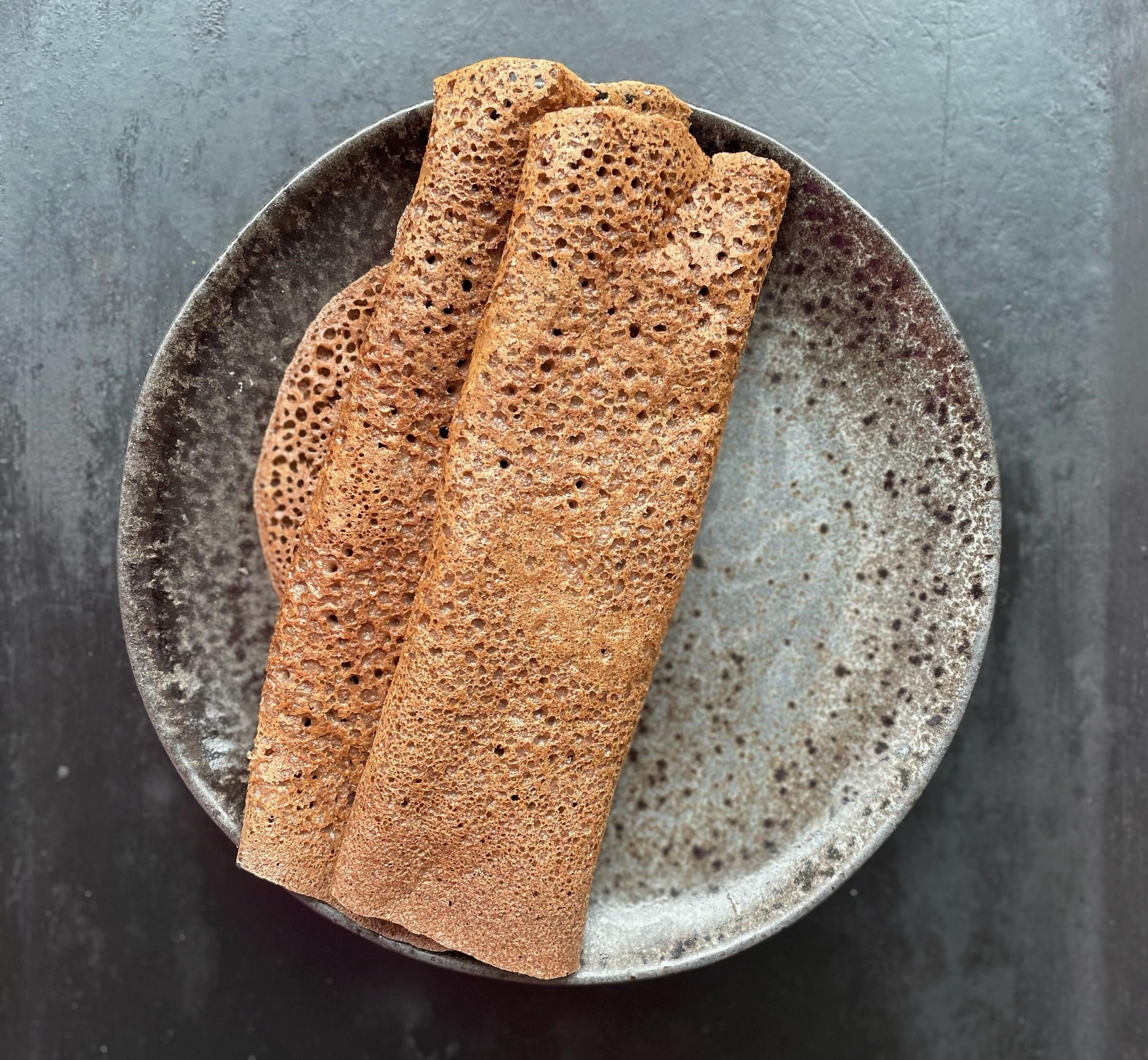
I wanted to share a recipe with you today that is almost ridiculously simple and yet beguiling in it’s complexity. Injera bread hails from Ethiopia and Eritrea, made from the tiny nutritional powerhouse teff, which thrives in that environment. It is possible to make injera from buckwheat, millet and sorghum too, once you’ve learnt the method. You might even try some of the lesser used millets that I discuss in my book, like foxtail or fonio. It’s sourdough, but you don’t need a starter to make it. Teff ferments pretty spontaneously if you treat it right. It doesn’t contain psyllium or egg or anything other than a little technique called a ‘roux’, like making a white sauce or bechamel, which holds water in the batter.
You need a good pan with a lid for this. Injera partially steams and that lid needs to trap the moisture created by the batter so that the injera starts to lift like magic around the edge of the pan when it is ready.
Then you’ll need something rich and spicy to eat it with. The sourness of injera makes perfect sense when you scoop up a fragrant stew, rich with caramelised onions and berbere spice. A gingery, cardamom infused, sour sweet mouthful you won’t forget in a hurry. Then the injera bread is like a rainy morning after a month of sun and dust. It will delight you just the same.
Before I get to the recipe, I want to remind you that I am also hungry for book reviews. Thank you to everyone who has already written one. They are so wonderful. I’m offering a £30 discount on cookery school courses for each review, just email me, DM on instagram or respond to this post with a screen shot, or let me know what name you posted the review under and I will send you the code. Here are some of the mini courses that you’ll get for free with that code. The button below takes you to Amazon UK, but you can post wherever you bought your book.
Happy baking and much love,
Naomi x


Injera Bread
(adapted from BREAD gluten free)
DOUGH
280g brown or ivory teff flour
190-200g un-chlorinated water 40ºC/104ºF
20g cold sourdough starter straight from the fridge (feed once if your starter has been dormant for more than 2 weeks) or milk kefir or in summer, just leave this out.
FLOAT
180-200g un-chlorinated water 30ºC/86ºF
ROUX
40g buckwheat flour (or more teff)
200g un-chlorinated water
BATTER
100-150g water
METHOD
1. Make the dough. Mix teff flour, water and sourdough starter (or kefir or leave it out) to form a firm dough that peels away from the sides of the bowl.
2. Squash the dough into the base of a bowl and carefully pour the float water over it, to submerge. Cover with a cloth and set aside for 12-24 hours depending on how sour you want it. The dough should rise up and may absorb all of the water. To test for sourness, dip a clean finger into the dough and taste. The batter will be a little more sour than this.
3. When the dough has fermented enough, pour any excess float water into a separate bowl and set aside while you make the roux.
4. In a small saucepan, mix roux flour and water and bring to a simmer over a medium heat, stirring constantly, until it thickens. Scrape into a clean bowl and allow to cool to lukewarm (40ºC/104ºF) then beat into the dough.
5. The batter should be able to lightly coat a spoon, but not so thick that you can’t see the spoon. Add to the batter any FLOAT water that you reserved and then as much of the BATTER water as you need to get the right consistency. If you are unsure, you can do a test with a small bit in a pan.
6. Pour into a jar or bowl and allow to ferment for 1-4 hours until you can see bubbles forming. Taste to check it’s not getting too sour. Or put straight in the fridge for up to 6 hours.
7. To cook injera; wipe the surface of your cast iron pan with oil, slowly heat on medium and then thoroughly wipe the fat away again. You aren’t frying injera, this primes the pan so it won’t stick as much.
8. Pour batter in a spiral into the pan so it rolls towards the edge, but don’t swirl the pan like a crepe, just allow it to form a layer with a meniscus. Right away little ‘eyes’ (bubbles/holes) will start to form at the edge of the injera. If the whole surface starts to look dry almost immediately, turn down the heat, or pour in more mixture next time.
9. About a minute later when 60% of the ‘eyes’ have formed, put a lid on until you can see wisps of steam escaping. Lift the lid and see if the surface feels just set and the edges lift if you tease them with a palette knife. injera is very delicate so take care.
10. Use the palette knife or a sharp edged spatula to work around the edge of the injera and loosen it from the pan, lift it onto a plate and allow to set before rolling up, or stacking, or it will stick together.
11. Repeat until all the batter is used. You can keep the batter in the fridge for another 24 hours, but it will continue to sour.


